from Britain & Ireland
Hot toddy
You need
- Whisky
- Honey
- Lemon
- Hot water
- A clove or two
Build it in a glass, drink it hot, go to bed.
For a cold and for the sleep that a cold interrupts.
Warm, sweet, sharp. Best sipped rather than drunk.
There is a particular moment — a scratch at the back of the throat, a heaviness behind the eyes — when you know it is coming and it has not properly arrived. Almost every culture has something it reaches for in exactly that hour, and a striking number of them reach for the same three things.
Read in the order the sun finds them — west to east, following the numbers.
You need
Build it in a glass, drink it hot, go to bed.
For a cold and for the sleep that a cold interrupts.
Warm, sweet, sharp. Best sipped rather than drunk.
TSVEE-bel-zaft
You need
Chop the onion, cover it with sugar in a jar, and leave it a few hours. It draws out a syrup. A teaspoon at a time.
The German household cough syrup, made for children for generations.
Sweet first, then unmistakably onion. It is stranger to describe than it is to take.
um-shlon-YAH-neh
You need
Steeped as a tea, or the steam breathed in from a covered bowl.
The South African cold and flu remedy, in gardens and kitchens across the country.
Very bitter and strongly aromatic. Not a pleasant cup, and not meant to be.
uh-la-MOOR
You need
Steep the blossom for five minutes, add lemon and honey to the cup.
The Turkish default for a cold — sold on every corner in winter.
Honeyed and soft, with the lemon cutting through.
You need
Stir the jam into the tea. Then get under a blanket and sweat.
To break a fever by sweating it out — and to be looked after while it happens.
Sweet, sharp, and inseparable from being cared for.
काढ़ाKAA-dha
You need
Simmer everything in water until it reduces by about a third — ten to fifteen minutes. Strain. Sweeten off the heat if you are using honey.
Pungent and warming, to dry dampness and rekindle digestion, which Ayurveda treats as the thing that falters first when you get ill.
Sharp and properly medicinal. Nobody drinks kadha for pleasure, and everybody drinks it.
koth-tha-MALL-ee
You need
Crush the seeds, simmer for ten minutes, strain. Drunk at the very first sign, and again at night.
The universal Sri Lankan answer to a cold — so common that a household without coriander seed is unprepared.
Warm, faintly citrusy, much gentler than it sounds.
ฟ้าทะลายโจรfah ta-lai jone
You need
Taken at the very first sign, for a few days only.
Used in Thailand for early fever and colds, and included on the country's own national list of essential medicines.
Extremely bitter — the plant's Thai name translates roughly as 'sky-destroying thief'.
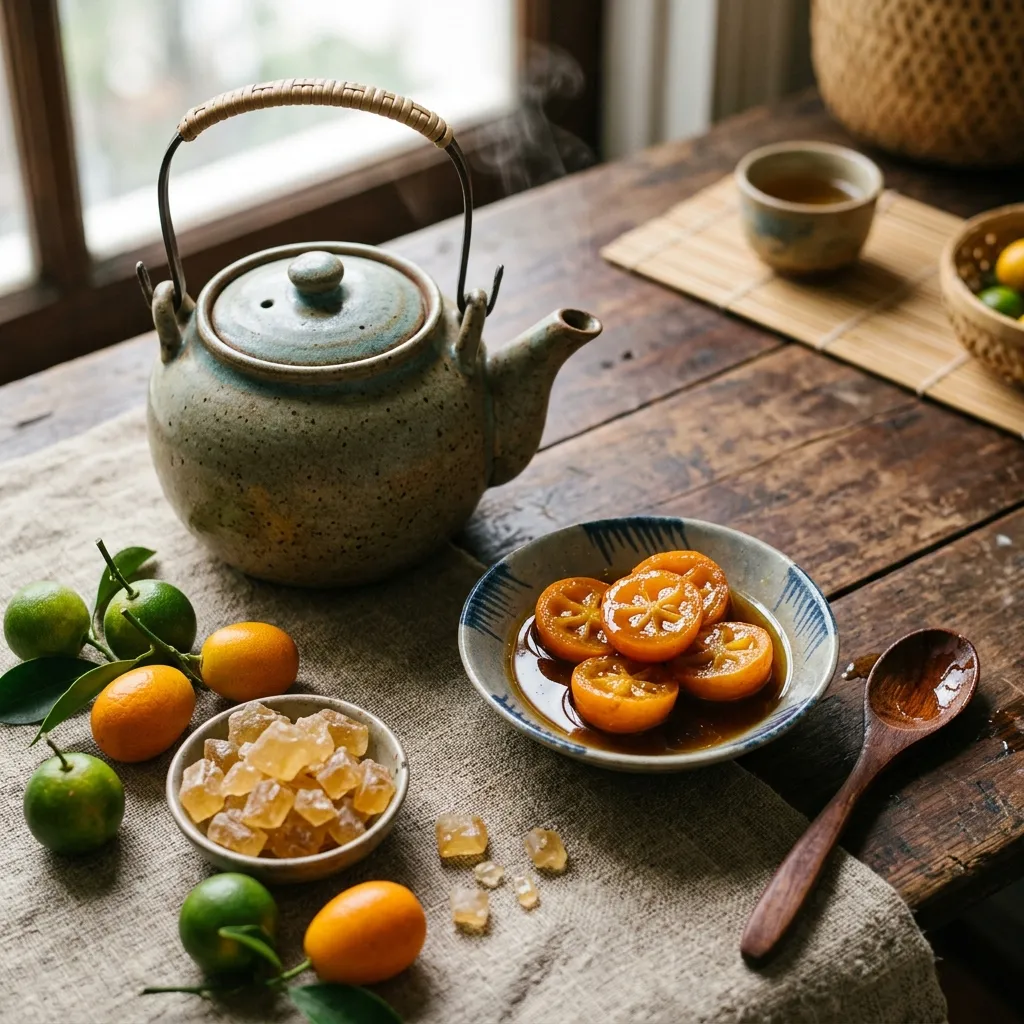
You need
Steam the fruit with sugar until it collapses into syrup. A spoonful at a time, straight.
The Vietnamese cough remedy for children, and given to adults with no ceremony.
Sweet, sour, a little bitter from the peel. Children take it willingly, which is the point.
冰糖雪梨bing tahng shweh lee
You need
Core the pear, sit the sugar in the hollow, and steam it whole for half an hour. Eat the fruit and drink the syrup that collects.
For a dry cough specifically. Chinese medicine reads that as dryness, and answers it with something moistening and cool rather than hot.
Like a poached pear, because it is one. The nicest remedy in this whole collection.
유자차YOO-ja-cha
You need
A generous spoonful of the preserve stirred into hot water, peel and all.
For sore throats and colds, and made in autumn so that a jar is always waiting in the fridge by winter.
Bright, bitter-sweet, marmalade in a cup. Wonderful on a raw throat.
Imagine hot lemon and honey, but made with the whole fruit and much more interesting.
生姜湯SHOH-ga-yu
You need
Grate the ginger straight into the cup, pour on hot water, stir in honey. With kudzu it thickens into something closer to a warm broth.
Japanese households treat chills as the thing to head off first — warm the body before the cold settles in.
Clean and hot, and with kudzu, oddly soothing to swallow.
Honey appears in almost every kitchen that has bees, and ginger in almost every kitchen that can get it. But look closer and the traditions split on something interesting: several of them distinguish a dry cough from a wet one and treat them oppositely — China stews a pear for a dry cough, India warms and dries with pepper for a loose one. Most modern over-the-counter advice does not make that distinction at all.
None of the above is medical advice. These are household preparations, described as the households that make them describe them. They sit alongside medical care and never in place of it.
With warmth, from a great many kitchens.