PMOS: the new name for PCOS, and why Ayurveda saw it coming
In May 2026, polycystic ovary syndrome was renamed to say what it always was — a whole-body hormonal and metabolic condition. Ayurveda never located it in the ovary either.
A woman comes in with periods that arrive when they feel like it. Weight that will not move. Acne at thirty-four. Hair growing where she does not want it, and thinning where she does.
She has a scan. The ovaries look normal.
She is told she does not have PCOS.
That happened to a great many women. It was usually wrong. And in May 2026, it is part of why the condition got a new name.
What changed
Polycystic ovary syndrome (PCOS) is now polyendocrine metabolic ovarian syndrome (PMOS).
The change was published in The Lancet, agreed by 56 medical and patient organisations, after asking around 22,000 patients and doctors what the condition should be called.
Your diagnosis has not changed. Your treatment has not changed. Both names will be used for a few years.
What changed is where the name points.
The old name pointed at the ovary. It said cysts. But what a scan shows are not cysts — they are small eggs that started to develop and stalled. And many women with the condition never have them at all. They were sent home because of it.
The new name points at the hormones and the metabolism. That is where the condition actually lives.
Why this is familiar ground for Ayurveda
Ayurveda never put this condition in the ovary either.
There is no classical disease called polycystic ovary syndrome. What the texts have is a way of thinking that starts somewhere else entirely — with digestion, and with what happens to a body when the fire that turns food into tissue goes down.
Read that way, the ovary is not where the problem begins. It is where the problem shows up.
How Ayurveda reads it: the samprapti
Ayurveda groups women's reproductive disorders under yonivyapada. No single classical condition matches PMOS exactly — anyone who tells you otherwise is overselling. But several overlap closely, and the one most often used is artava kshaya: artava, the menstrual and reproductive essence, become diminished.
The chain that produces it looks like this.
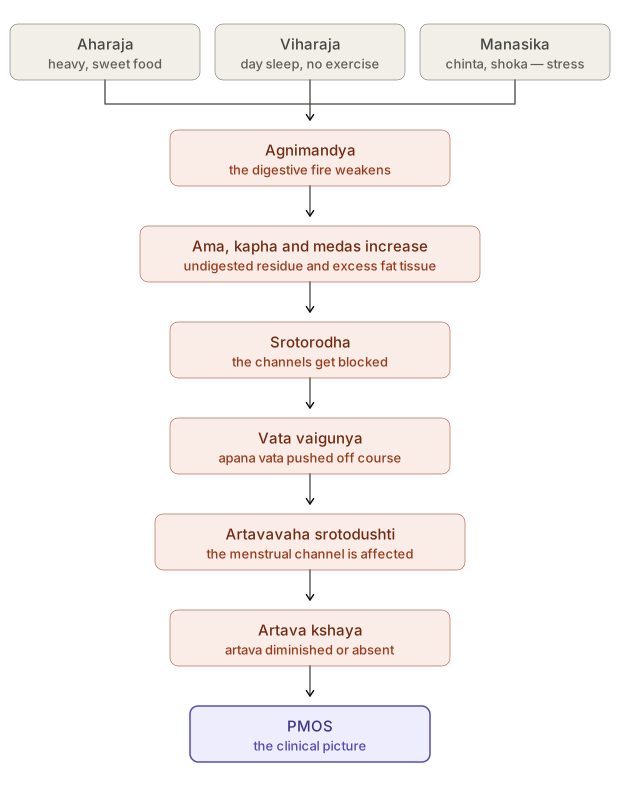
The samprapti — how the condition builds.
It starts with food, habit and mind. Heavy, sweet, oily food. Sleeping in the day. Not moving. And worry and grief, which the texts treat as physical causes, not soft ones.
The fire goes down. Agni, the digestive fire, weakens. This is the hinge.
Waste builds instead of tissue. Undigested food becomes ama — sticky residue. Fat and heaviness increase. The body stores what it should have used.
The channels block. Srotorodha. The passages that carry nourishment get clogged.
Vata gets pushed off course. Apana Vata , the downward-moving air that governs menstruation cannot travel properly. It is not weak — it is obstructed.
And the cycle fails. The artavavaha srotas, the channel that carries artava, is disturbed. Periods become scanty, late, or stop.
Notice what is missing from that chain: the ovary. It appears only at the end.
The same story in modern words
The body stops responding to insulin. The pancreas makes more of it. High insulin pushes the ovary to make extra testosterone, and extra testosterone stops eggs maturing — so ovulation fails and periods go irregular. Fat tissue misbehaves, inflammation rises, and the insulin problem worsens. The loop feeds itself.
Agni failing, waste building, channels clogging, the cycle stopping. Insulin failing, fat misbehaving, inflammation building, ovulation stopping.
Different vocabularies. Very similar shape.
How Ayurveda treats it
The order matters more than the ingredients.
First, restore the fire. Nothing works until digestion does. Trikatu churna — dry ginger, black pepper, long pepper — and similar preparations. Skipping this is the most common mistake: reproductive tonics given to a woman with weak digestion mostly add to the problem.
Then clear the blockage. Kanchanara guggulu is the classical formulation here, and triphala alongside.
Then reduce the heaviness — turmeric, fenugreek, giloy. How far to push this is a judgement. These drugs are drying, and a woman already depleted cannot take much drying before her periods get worse rather than better.
Only then, the reproductive herbs. Shatavari, shatapushpa (Indian dill), latakaranj, shivlingi and kaunch — the drugs the classical yonivyapada chapters name — and ashokarishta.
All of this is prescribed after an examination. A list is not a prescription, and several of these must stop once you conceive.
What you can do yourself
A large share of this responds to daily habits, because digestion and rhythm are what the whole chain hangs on. Regular warm meals, no daytime sleeping, movement most days, and proper sleep at night. We have set that out in detail in part two.
Still get checked
Ayurveda manages this condition well. It does not replace the tests.
See someone if your periods come more than 35 days apart or fewer than eight times a year, if you have had none for three months, if you notice new facial hair or dark velvety patches at the neck, or if you have been trying to conceive for a year. And once diagnosed, have blood sugar and cholesterol checked periodically — the long-term risks here are metabolic, which is the whole point of the new name.
This article is for educational purpose , not a prescription. It does not replace your doctor, your Vaidya, or your medication. Thyroid and other conditions can look similar and need ruling out.
Educational content, not medical advice. Ayurveda is complementary to medical care, never a replacement for it. Talk to a Vaidya or your doctor before changing anything you take.
Five minutes. No card.